Annual General Meeting 2010
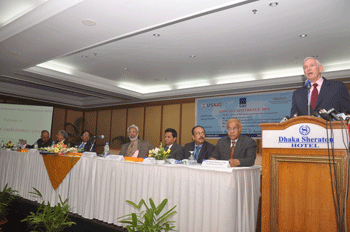
IBFB organized its Annual Conference of 2010 on 13 March 2011 at Hotel Sheraton in Dhaka.

IBFB organized its Annual Conference of 2010 on 13 March 2011 at Hotel Sheraton in Dhaka.
IBFB strives to identify all common challenges and obstacles faced by the business community and we, as a nationwide trade body, conduct advocacy for policy reforms. Mr. Mahmudul Islam Chowdhury, while delivering his opening speech in the IBFB Annual Conference-2010, hoped these will improve the business climate in Bangladesh and have a strong and positive impact on governance that enhances trade, commerce and investment thus improving the overall economy of the country.
Aimed at disseminating as well as approving overall activities and achievements, audit report for the year ended 2010 and conducting elections for the vacant positions in the Board of Directors, IBFB organized its Annual Conference of 2010 on 13 March 2011 at Hotel Sheraton in Dhaka. Explaining the vision, mission and objectives of the Forum, IBFB President added that being non-partisan and non-political IBFB has every intention to promote just causes for transparent and good governance, especially when it pertains to the economy of Bangladesh. As a membership-based organization, we already have around 270 members from home and abroad and we wish to have our chapter office/branches in some other metropolitan cities. We also extend our hands to all other trade bodies to fight together in formulating national policy making and reforming to work as a driving force for our economy.
The IBFB President opined that as an alternative to the RMG sector, Bangladesh should now look for other industries to compensate the foreseeable fall in economic growth. Our growing Pharmaceutical industry and emerging sectors like shipbuilding, ceramics, plastic etc. provides a good window of opportunity for exports. In addition, the northern region of the country can play a vital role for agro-based industries as it is virtually the “food basket” of the country. At the same time, it is imperative that development of diversified agro-based and specialized industries accompanying infrastructure development in the region will eventually contribute to large scale rural employment. IBFB President recited that the Strategic plan of IBFB includes reducing the cost of capital, popularizing the use of alternative energy, development of the agribusiness sector, developing manpower for export, improving the tax administration, infrastructure development, effective local governance, reducing the culture of bureaucratic red tape and corruption, etc. He thanked USAID for their supports and cooperation to IBFB through USAID-PROGATI (Promoting Governance, Accountability, Transparency and Integrity) and hoped that such institutional ties will remain continued in days to come.
The Annual Conference was conducted in three sessions – Opening Session, Annual General Meeting (AGM) and Social Interaction Session. His Excellency Mr. James F. Moriarty, Ambassador of the United States of America in Bangladesh was present as the Chief Guest in the opening session, whereas Mr. A K Azad – FBCCI President, Dr. Mohammad Farashuddin – former Governor of Bangladesh Bank, Maj. Gen. (Retd.) Amjad Khan Chowdhury – MCCI President participated as Special Guests. In the evening session, Ms. Denise Rollins – USAID Mission Director in Bangladesh attended as the Chief Guest, where Mr. Kyrre Elvenes Braekhus – Deputy Head of Mission of Royal Norwegian Embassy in Bangladesh and Ms. Selima Ahmad – BWCCI President were also present as Special Guests.
Opening Session:
During his speech as the Chief Guest, the US Ambassador in Bangladesh Mr. James F. Moriarty said the business leaders have important role to play in fighting against corruption by promoting the principles of transparency, accountability and integrity. He told that transparency in financial management is very important. Corruption is a two-way street – a demand side and a supply side – and the government’s actions are of huge importance in fighting corruption. Private sector actors are both the victims of corruption as well as contributors to the systems that promote corruption. In every area where the private sector is challenged by corruption, the cost of doing business increases, foreign investment slows down, markets are disrupted and the Bangladesh economy suffers. About the IBFB, the US envoy expressed hopes that the trade body would not only advocate for a better environment to do business in Bangladesh, but would also play an active role in the fight against corruption. Mr. Moriarty hoped that the IBFB, established in 2005, would focus on business ethics and standards within private sector and would identify the role of private initiatives to reduce corruption, which he said, slowed down foreign direct investment in Bangladesh.
|
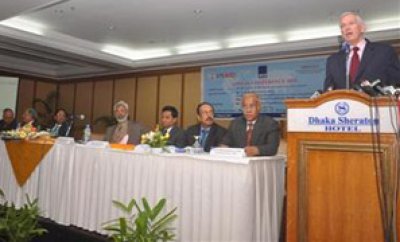
HE James F. Moriarty, Hon’ble US Ambassador in Bangladesh speaks as the
|